We’ve already refuted earlier conjectures and shown that the coefficient of in the diameter growth exceeds , a first example in more than 50 years of similar studies. We estimate this coefficient at , and its exact value remains open. A famous conjecture puts a upper bound on these diameters, and the optimal constant remains unknown.
We’ve also found surprising results on the quasi-polynomial behavior of word metrics, the spectrum, and connections to AI and holography.
133moves · 16 items
The 16-item diameter
Some permutations of 16 items need 133 moves, and every permutation can be sorted in at most 135. We started with an upper bound above 160. The exact worst-case count remains open.
Proof trail
- Certify a hard permutation. Exhibit a 133-move sorting word and rule out every shorter word for that target. Lower-bound witnesses
- Reduce the search. Group states by symmetries and traverse the reduced graph. The completed enumeration covers 217,945,728,000 reduced states. Traversal and reproduction
- Cover every original case. Use projection bounds for cases they settle and replay sorting words in the original moves for the remaining cases. The combined coverage certifies the 135-move upper bound. Completed search and proof
Open trail in Atlas
moves
Diameter estimation
We proved that converges to a limit and established the bounds
The natural candidate for the limit is , but whether the limit is rational remains open.
Proof trail
- Show that the limit exists. Approximate the sorting problem with finite diagrams and control the error as their resolution increases. An independent review checked the convergence argument and its dependencies. Convergence review
- Build a hard family. A construction with a five-position window raises the lower bound to 0.55804. An independent verifier reproduced the bound and its 394-case rational certificate. Lower-bound audit
- Bound every permutation from above. A universal sorting construction and a counting argument give a strict improvement below . The candidate limit remains open. Upper-bound proof
Open trail in Atlas
x ↦ ax + bpermutations
Quasi-polynomials for lengths
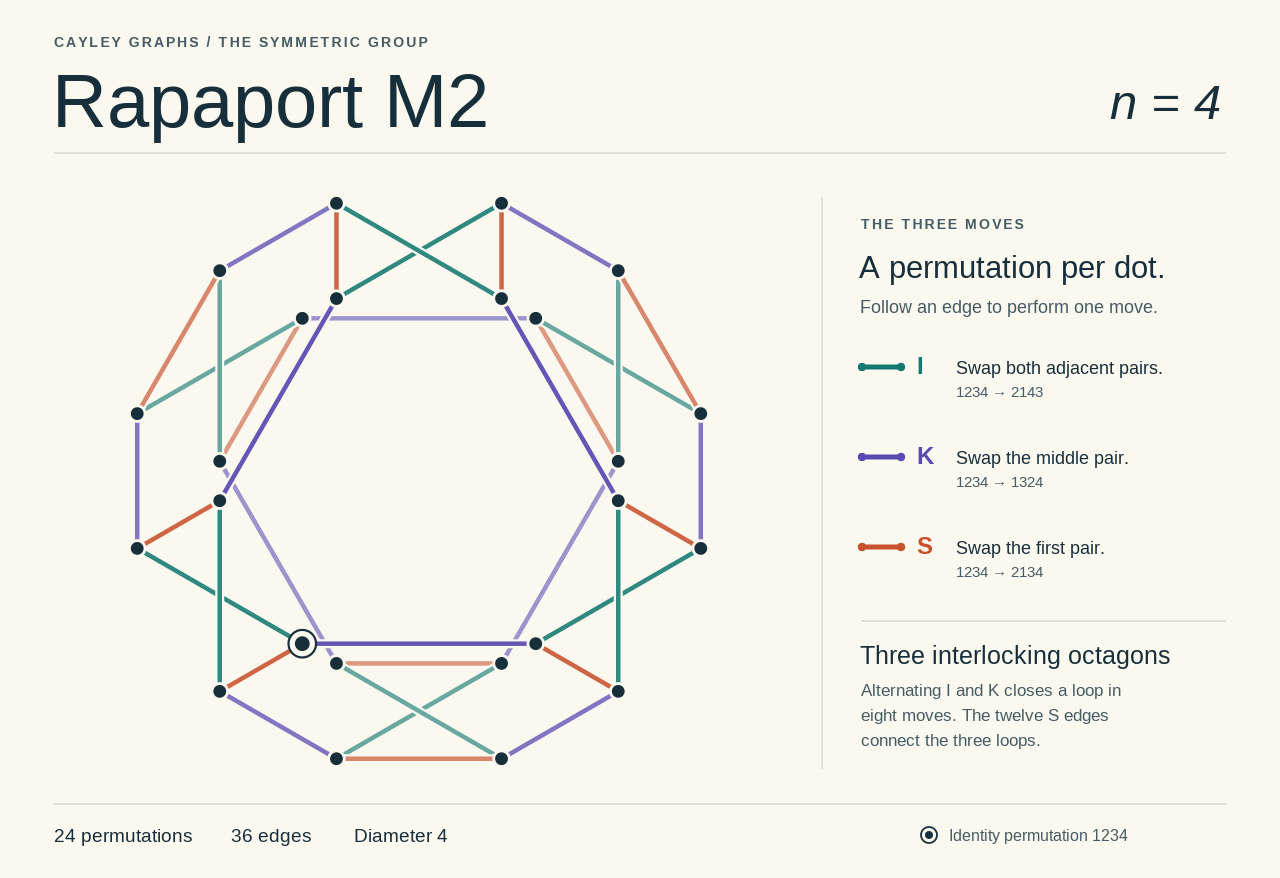
Consider the permutations for fixed integers and , with . What are their word lengths in the Rapaport M2 generators? We expect these lengths to be quasi-polynomial in . Some cases have been proved, and the general question remains open.
Proof trail
- Look for patterns in exact distances. Small cases of the doubling permutation gave different quadratic fits depending on the size modulo four. Finite computations
- Stress-test the fit. Larger certified lower bounds exceeded the proposed formula for ordinary move counts. That left the finite computations intact and ruled out their extrapolation. Counterexamples
- Solve a special case in the ordinary metric. For the unshifted doubling riffle in cycle coordinates, an explicit construction and matching lower bound give exact lengths with a periodic correction. Exact riffle result
- Prove a formula in a related metric. When only the swap move costs one and the other two moves are free, fixed affine families have eventual quasi-polynomial lengths of degree at most two. Ordinary move counts remain open in general. Swap-only theorem
Open trail in Atlas